
Every organisation creates value by solving a problem, but often creates secondary environmental or social challenges in the process. The strongest impact strategies focus on mitigating the negative externalities most closely linked to the organisation’s core business model.
Responsible business is no longer a nice-to-have or a box to tick – it is one of the defining factors of long-term business success. The organisations that thrive in a rapidly changing world are those that create value not only for shareholders, but for customers, communities and society as a whole.
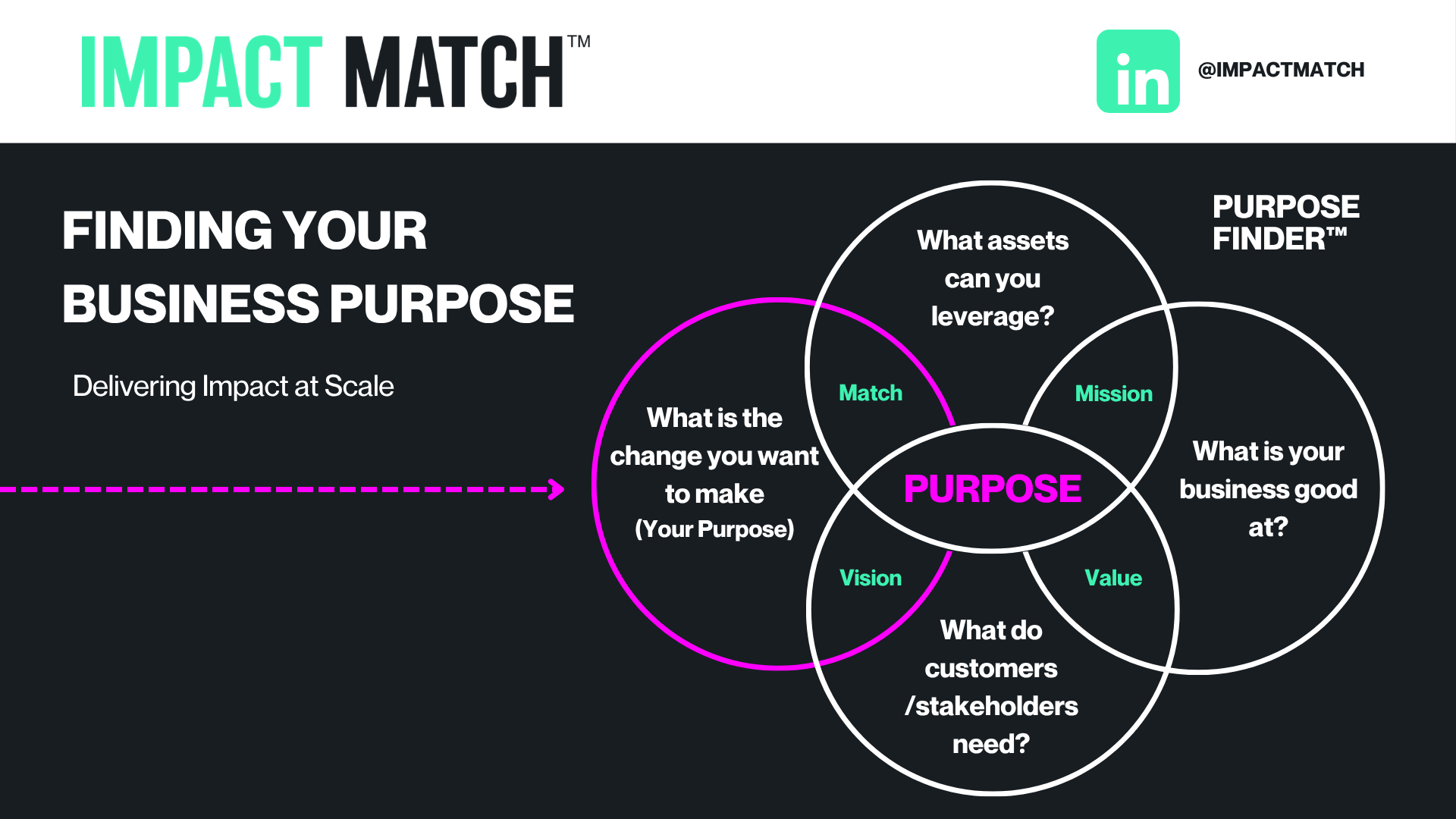
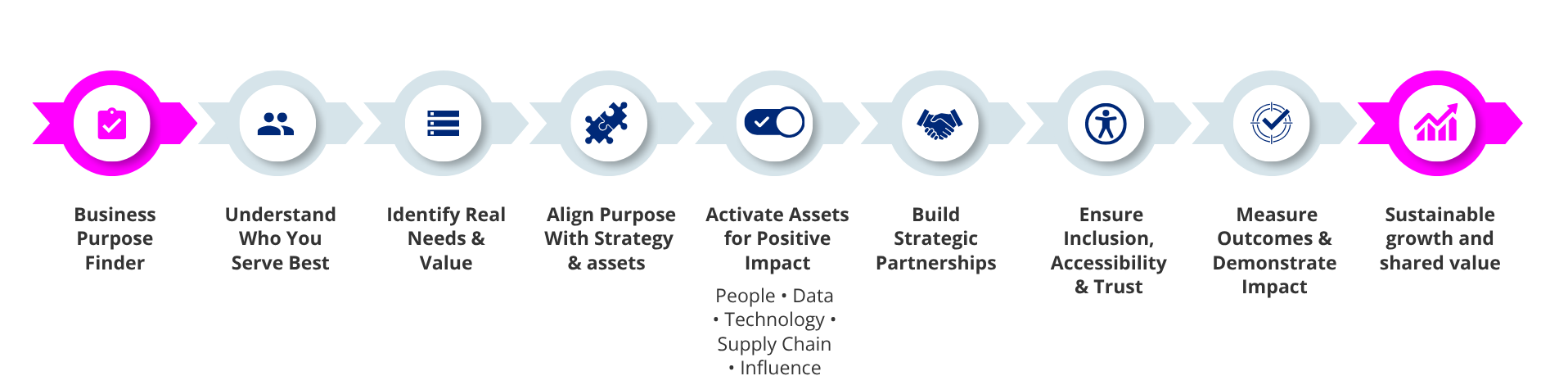
At ImpactMatch, we help organisations identify where purpose and commercial value intersect through frameworks such as the Business Purpose Finder™. This approach starts with a simple question: who genuinely needs our product or service, and how can we create more value for them? When businesses understand the real needs of the people they serve, they uncover opportunities for growth, innovation and impact at the same time.
Responsible business works best when it is connected directly to business goals. Impact should not sit alongside strategy; it should strengthen it. Through our masterclasses, one-day accelerators and tools, including the Business Purpose Finder™ and our IM strategic planning frameworks, organisations learn how to align commercial success with measurable outcomes that improve people’s lives, strengthen communities and build long-term resilience. Our one-day accelerators are particularly popular with busy leaders and boards because they create the space for focused thinking from the perspective of end users and rapid progress without requiring a significant time commitment.
That also means taking responsibility for the challenges a business may unintentionally create. Whether it is barriers to access, exclusion from digital services, environmental impacts or unintended consequences of new technologies, responsible businesses actively identify and address these issues. Increasingly, the most effective social impact comes not from writing a cheque, but from fixing the problems that exist within your own products, services and value chain.
There is growing evidence that this approach delivers meaningful results. For example, internet service providers have recognised that digital exclusion can be an unintended consequence of how connectivity is delivered and accessed. In response, many have invested in social tariffs, affordable broadband programmes, digital skills initiatives and accessibility improvements to help more people participate in the digital economy. Similarly, ride-hailing companies have improved access to flexible, convenient transport, particularly for people underserved by traditional transport networks. But they can also contribute to congestion, emissions and unequal access if those impacts are not actively managed. The opportunity is to use the business model itself as the route to impact: investing in EV adoption, shared mobility, accessible journeys and better driver conditions. Financial institutions have redesigned services to improve accessibility for vulnerable customers, while technology companies have embedded accessibility features into products that benefit millions of users. These actions address root causes rather than symptoms and often create both social value and commercial advantage.
Research from organisations including the World Economic Forum, Harvard Business School and Deloitte has consistently shown that businesses which integrate stakeholder needs, trust and long-term value creation into their strategy are more resilient, innovative and better positioned for sustainable growth. The evidence increasingly points to a simple conclusion: solving problems linked to your business can create greater impact than funding unrelated initiatives.
Before reaching for donations, look at the assets your business already controls. Our Impact Assets Framework™ encourages organisations to map and activate their value chain, purchasing power, technology, data, platforms, expertise and influence as tools for widening opportunity and solving real problems. The question is not simply what you can give, but what you can change. The best legacy strategies I wrote and delivered e.g. the Consumer Index and Digital Academy use the main data and partnership assets of the FS sector.
Partnerships remain important, the key is that their value should extend beyond funding. The strongest collaborations combine capabilities, networks and knowledge to deliver practical outcomes. Effective partnerships unlock access, improve services, create opportunities and help organisations achieve results that neither could deliver alone. ImpactMatch’s Partnership Value Framework™ and strategic planning frameworks help organisations identify where collaboration can create the greatest shared impact.
In a digital economy, inclusion and accessibility are fundamental responsibilities. If people cannot access your products, services or information, they are excluded from opportunity. Businesses should be designing for accessibility from the outset, investing in digital skills and ensuring that technology works for everyone, not just the most connected or confident users.
The same principle applies to artificial intelligence. AI presents enormous opportunities, but responsible deployment is critical. Organisations must consider transparency, fairness, accountability and accessibility as core business issues. This is alongside the important question of how we support our people supporting the bots. Trust will increasingly become a competitive advantage, and businesses that use AI responsibly will be better positioned to earn and maintain it.
Purpose only matters when it leads to action and impact. Ambition is important, but measurable outcomes matter more. Responsible business requires clear objectives, accountability and evidence of progress. We often begin by helping organisations develop their Theory of Change (insert links), creating clarity on the outcomes and impact they want to achieve (based on evidence!) and how they will measure success. It means embedding impact into decision-making, operations and culture rather than treating it as an optional extra.
Just as importantly, organisations need to share the impact they are creating. Platforms such as LinkedIn can be powerful tools for raising awareness of your work, demonstrating leadership and connecting with other leaders who are tackling similar challenges. Thoughtfully communicating your impact helps build trust, attract partners, inspire employees and create opportunities for collaboration. Many organisations underestimate the value of sharing what they are learning and achieving. If this is an area you would like to strengthen, we cover practical approaches through our masterclasses and accelerators, helping leaders communicate impact effectively without adding significant demands to already busy schedules.
The greatest opportunity for business lies in recognising that doing good and doing well are not competing goals. Organisations that make usefulness, access and fairness central to how they operate are better positioned to innovate, earn trust and achieve sustainable growth. In the years ahead, the businesses that stand out will not be those that simply minimise harm, but those that use their influence, resources and ingenuity to expand opportunity and create lasting value for more people.
If you would like to explore how to build the internal case for connected leadership and responsible business, we also offer a free Connected Leadership Business Case resource. It is designed to help leaders engage stakeholders, secure buy-in and demonstrate the value of investing in impact-led approaches. DM us for a copy.
- Learn more about ImpactMatch frameworks, accelerators and masterclasses
- Connected Leadership Business Case – Contact us for your free copy
- ImpactMatch: https://impactmatch.global
Leigh Smyth, Founder, ImpactMatch – helping organisations create impact by solving the challenges closest to their business and turning responsibility into opportunity.
